Introduction
“…all over again” - Yogi Berra
The stock market sold off hard—then recovered almost as fast.
Sound familiar? We watched this same scenario unfold almost exactly a year ago.
So, next time, we should be ready to “buy the dip,” right?
If only.
The stock market sold off hard—then recovered almost as fast.
Sound familiar? We watched this same scenario unfold almost exactly a year ago.
So, next time, we should be ready to “buy the dip,” right?
If only.
During this most recent bout of volatility, I described our portfolio adjustments as checking on the wolf.
Here’s what I mean.
The market cries wolf from time to time. A storm rolls in, fear spikes, and investors brace for something more sinister on the horizon. Many times, it’s a false alarm—the wolf is a mirage, and calm returns.
Every once in a while, the wolf is real.
That’s the problem: we never know which one it is until after the fact.
That uncertainty is why risk management is one of our top priorities.
At Continuum, don’t just diversify across a few different stock and bond funds. We layer multiple investment styles specifically to prepare for what we can’t predict.
Checking on the wolf isn’t about finding it.
It’s about never being caught off guard if we do.
___
Chart Of The Month
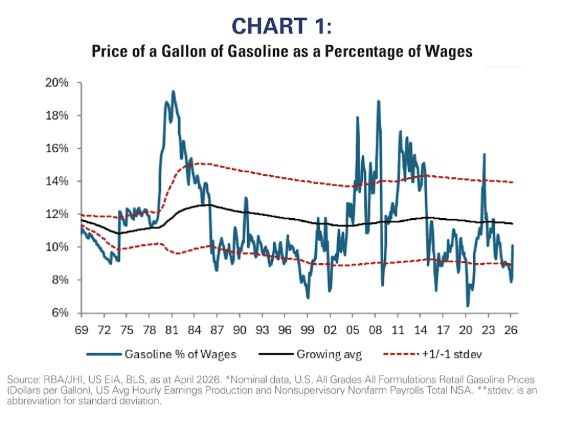
There is a bull market in pictures of pump totals in the group chat.
Here in Upstate New York, gas has climbed above the psychologically important $4/gallon level.
Gas prices are the most in-your-face measure of inflation. One can’t drive to work without seeing the current levels in large LED lights at every corner.
While the pain is visceral, relative to overall income levels, we are coming off of historic lows.
I’ve seen some point to this as evidence that the American consumer can withstand this energy shock.
In a vacuum? Sure.
In the real world, relative gasoline spending may have decreased from its 2008 peak, but inflation in other areas has filled the gap.
Healthcare. Housing. Insurance. Food.
All of this matters because it puts the Fed in a difficult spot.
As a reminder, the Federal Reserve tries to balance its policy between keeping people employed and preventing inflation from running rampant.
Oil prices can force them to pick one over the other.
For investors, that tradeoff would carry real consequences.