“Don’t fight the Fed.” - Marty Zweig
Last month, I talked about the newly appointed Fed Chair, Kevin Warsh.
After his first meeting and press conference this past month, I’m going to follow up by talking about how things will be different under his regime and why that matters.
The biggest difference: less is more.
Powell was known for verbose statements and lengthy press conferences to signal the Fed’s future intentions.
Wall Street traders would literally interpret a change from “probably” to “likely” in his statement to attempt to divine the Fed's future policy.
Now? Warsh’s statement was 130 words compared to 341 words in Powell’s last statement (yeah, they really track this stuff).
Warsh also declined to participate in the guessing game process of projecting future Fed rates.
His contention is that the market should react to data points rather than to the Fed’s reaction to those data points.
I can appreciate that sentiment—let the chips fall where they may instead of trying to massage the narrative.
However, with less guidance, markets may now start to price in greater uncertainty.
More uncertainty could lead to higher volatility on Fed decision days.
This probably won’t affect the long-term direction of markets, but it is something to be aware of as we enter a new paradigm.
Are We a Fit?
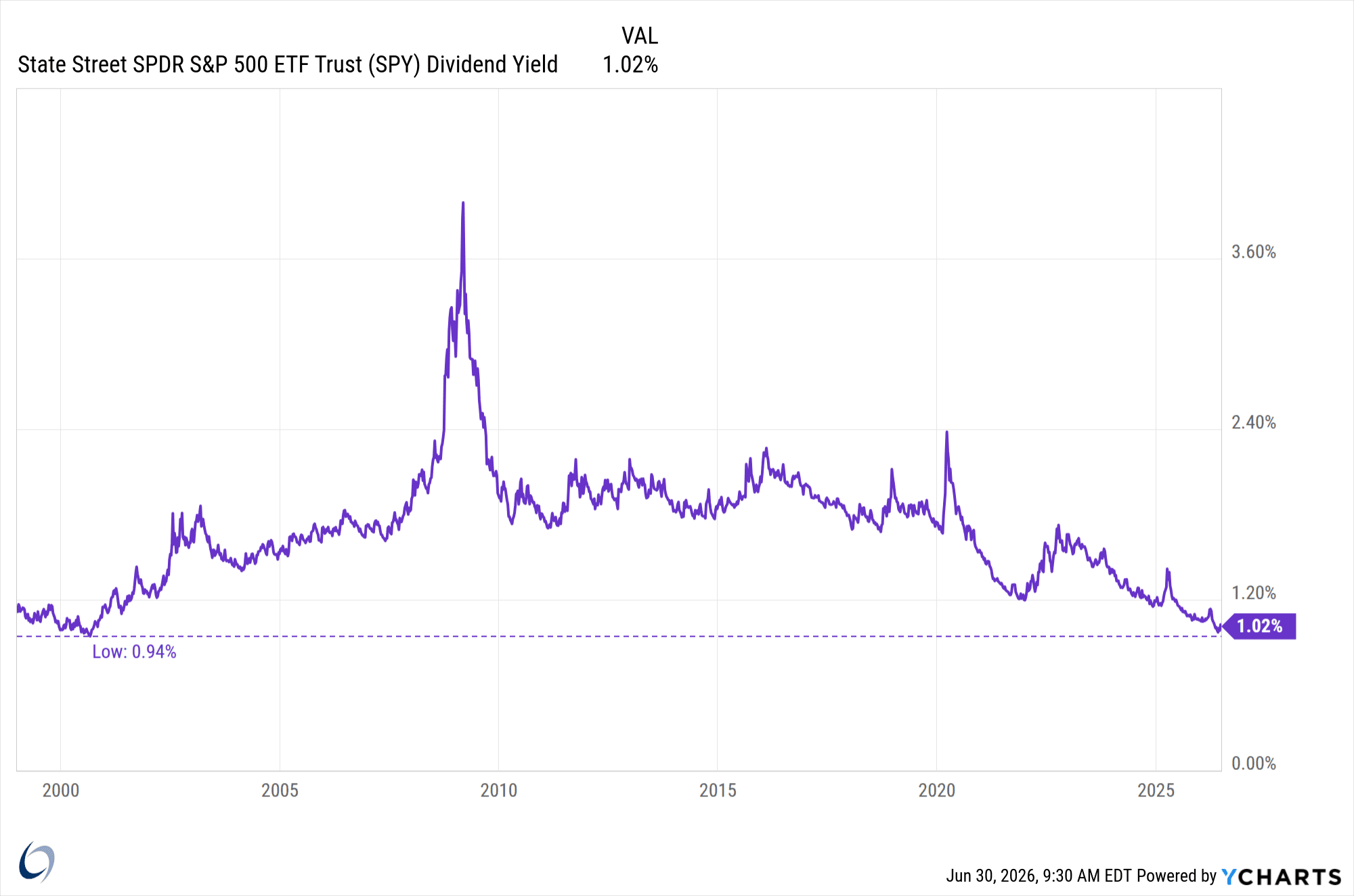
Rule of thumb: “Not seen since 2000” is usually not a compliment in the world of financial markets.
As the market continues to climb on the back of an innovative new technology, the parallels to that era keep mounting.
Case in point, the dividend yield on the S&P 500 is approaching levels not seen since 2000.
This matters because it reflects the relatively high price of the overall market versus something a little more predictable, like the dividends from component companies.
Is it a perfect indicator? Of course not…those don’t exist.
Is it instructive of our current situation? I think so.
No matter how you slice it, the market is expensive.
Before I go any further, let me be clear about one thing: valuation has a terrible track record as a timing tool.
“Ok, so what good is it if I can’t use it to time the market?”
Here’s how to think about this.
The market acts as a way for people to position their money to participate in the future growth of a company or a group of companies.
The higher the price that is paid, the lower the margin for error in the future.
While a valuation-based indicator does little to help with timing, it does inform investors about the cushion that exists if something does go wrong.
Keep that in mind as you set expectations going forward.