In This Edition
The bond market takes center stage
Forty trillion dollars (and counting)
Continuum Multimedia wrap
The Fed vs. The Treasury?
"I used to think that if there was reincarnation, I wanted to come back as the president or the pope or as a .400 baseball hitter. But now I would like to come back as the bond market. You can intimidate everybody."
— James Carville
Bonds are typically viewed as the boring option in portfolios.
In the last month, they have become the center of attention.
First, Treasury Secretary Scott Bessent announced that the Treasury Department will increase its purchases of long-dated bonds. While the official announcement doesn't signify much on the surface, the potential implications could be a major story.
I recorded a video breaking this down, which you can watch here.
Second, new Fed Chair Kevin Warsh delivered his keynote speech in Jackson Hole, WY this past Friday.
The bond market reacted by anticipating a higher probability of Fed rate hikes.
This is where it gets interesting — for me, at least.
The Treasury Department wants to keep long-term interest rates lower. Higher rates mean higher debt costs for Uncle Sam and for consumers.
The Fed seems headed toward higher short-term interest rates. This is their primary tool to combat inflation, which is staying stubbornly above their target — potentially at the expense of the economy.
Do you see the inherent tension?
Adding to it: if the Treasury Department does embark on a major bond-buying program to suppress long-term rates, it could be forced to issue short-term bonds. That might force the Fed to step in to stabilize short-term rates via bond purchases.
Fed Chair Warsh has stated a desire to reduce the amount of bonds the Fed holds on its balance sheet.
Bessent's actions could force his hand.
What does this mean for investors?
Any time a paradigm shifts, money gets repositioned to reflect the new reality.
For bond investors, the future depends on actions either taken or not taken by Warsh and/or Bessent.
Too many variables are involved to accurately predict a path forward, but we will continue to prepare for all outcomes and adjust accordingly, if necessary.
Not yet a client? Click below to see how we can work together.
Chart of the Month
What caught our eye?
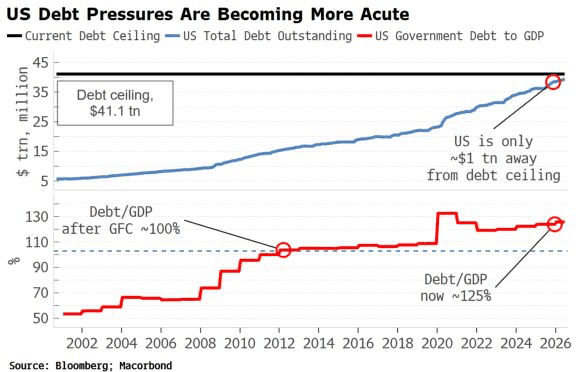
Speaking of debt — who is ready for another debt ceiling standoff in Congress?
In a somewhat maddening bout of déjà vu, the government appears primed for another round of arguing whether it should pay its bills instead of figuring out how to not have so many bills in the first place.
I won't opine on the state of our fiscal finances today, but I will tie it into the last section.
As the national debt increases, the government's sensitivity to interest rates becomes more acute by the day.
Please forgive the scary stat bites — not usually my style — but it is important to set the table for a discussion:
Projected $2T annual budget deficit
Nearly half of that deficit is just interest costs
Almost 20% of tax revenue goes toward interest costs
And this is with current interest rates.
Do you see why Bessent wants to keep a lid on rates?
Now the question becomes: how do we work our way out of this?
The dream scenario is that we grow our way out. Above-average economic growth leads to higher tax revenues, which potentially leads to a surplus.
The tough pill to swallow is a diet of higher taxes and reduced government spending.
In my opinion, the can will get kicked down the road until something forces our hand. (I guess I did end up opining.)
Keep an eye on their next move, because it has more to do with your portfolio than most headlines do.
Not yet a client? Click below to see how we can work together.
Continuum Multimedia
🎙️ Retirement Done Right Podcast
Pat and I used a conversation I had while waiting on line for a Mike Eruzione autograph to riff on retirement spending.
Listen on Spotify · Listen on Apple Podcasts
Be sure to subscribe on your podcast player of choice.
📺 In the Media
I was a guest on The Morning Show on Stock Market TV. Watch the segment
David Rath CMT, CFA