Introduction
“Meet the new boss.” - The Who
Fed Chair is one of the most powerful seats in the world, and we have a new person, Kevin Warsh, sitting there.
Fun fact: he is a graduate of Shaker High School here in NY’s Capital Region.
I’ve long thought that despite the power it affords, the position is one of the least desirable in the world.
The economy is notoriously tough to manage, and people are quick to point the finger at the person in charge of navigating it.
Add in political pressures, and it becomes a big “no thanks” for me.
What does the current situation look like?
President Trump has been very public with his desire for lower interest rates.
With that backdrop, Warsh inherits a potentially sticky situation.
The Fed’s primary tool is the Fed Funds Rate—think of it as the economy’s thermostat.
Cut rates to allow money to flow more freely.
Raise them to pump the brakes on inflation.
It’s an inexact science, and from time to time, the Fed is forced to choose between unemployment and higher inflation.
Inflation has been climbing, while the job market has held up better than expected.
This is an argument for higher rates—the opposite of what Trump wants.
So, what can we expect from Mr. Warsh?
As a Trump appointee, one might expect him to fall in line with the President’s desires at first and push for lower rates.
Without getting too wonky, official policy still gets voted on by members of the Federal Open Market Committee (it’s not just Warsh’s decision).
The bond market has other ideas, at least for now.
As a de facto prediction market, bond traders are pricing in a meaningful chance of a rate hike by the end of the year.
For investors, this would mean higher rates on savings and money market accounts.
On the flip side, higher rates have the aforementioned braking effect on the economy and stock market.
Trump got the Fed Chair he wanted. The economy may have other ideas.
Reach out to me to discuss how this may affect your portfolio.
____________
Chart of the Month
What caught our eye?
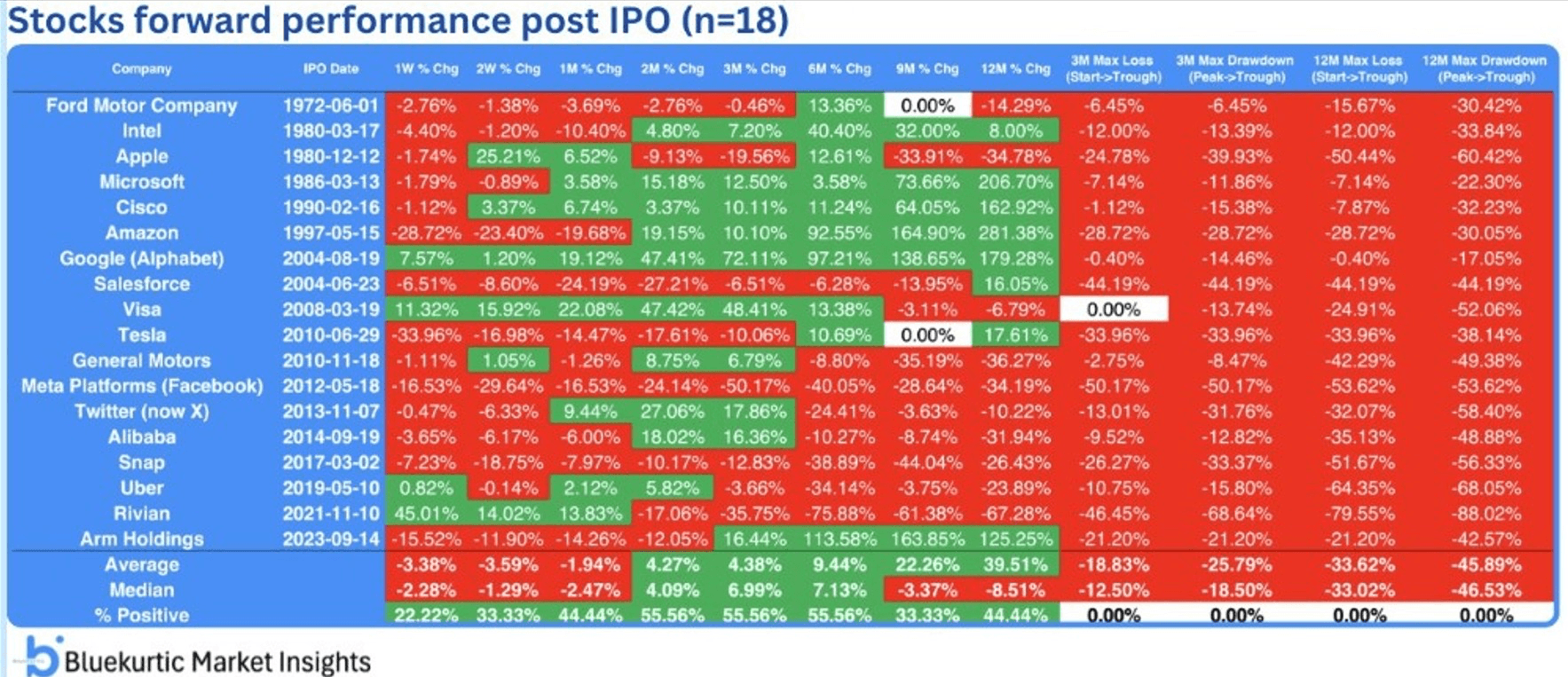
*Stocks forward performance post IPO (n=18)
SpaceX is the talk of the town—everybody is asking about it.
For those unaware, Elon Musk’s company will enter the public markets via an Initial Public Offering (IPO) this month.
For those looking to get a piece of the action, here are three important things you need to know:
On the first day of trading, there will most likely be a very wide price range.
Protect yourself by using trading instructions like a limit order, which specifies a price above which you are not willing to buy.
“Prediction? Pain.” - Clubber Lang, Rocky III
The chart above (apologies for the small text) shows a sampling of popular IPOs and their performance over the next 12 months.
The overall results are hit-or-miss (some really big hits and some really big misses), but the one constant is the pain investors endure during that 12-month stretch, regardless of the ending value.
The maximum decline from top to bottom across this sample averaged almost 50%.
It is estimated that SpaceX's total size will be between $1.6 and $2.0 trillion (yeah, with a T).
This is important because companies typically debut at much smaller sizes, which, conceptually, means they have more room to grow.
Of course, this doesn’t preclude SpaceX from seeing its stock price grow, but it does reduce the margin for error.
I know this isn’t what the hype machine wants to hear, but any money you invest in SpaceX should fit within your overall goals.
If you decide to buy some shares, heed the three points above and manage your expectations.